Quick answer
Bamboo weaving (竹编, zhúbiān) is the woven craft of Jiangnan, East China. Bamboo is split and shaved into thin, even strips, then plaited over and under — or set into a hexagonal weave — into baskets, trays, fans and boxes. It is national intangible cultural heritage, strongest around Zhejiang, Anhui and the water towns, and it is one of the most beginner-friendly crafts to try: about an hour or two at the table and you keep your piece.
Bamboo weaving at a glance
| Chinese name | 竹编 (zhúbiān) |
|---|---|
| Region | Jiangnan / East China |
| Home | Zhejiang, Anhui & the Jiangnan water towns |
| Status | National intangible cultural heritage |
| Material | Split bamboo shaved into thin strips |
| Makes | Baskets, trays, fans, boxes and mats |
| Technique | Over-under plaiting & hexagonal weave |
| Signature | Fine even strips, sometimes dyed for pattern |
A craft grown from bamboo
Bamboo has been split, shaved and woven across China for thousands of years, and in the damp, bamboo-rich hills of Jiangnanit grew into one of the region's defining folk crafts. Farmers and artisans wove the everyday objects of village life — baskets, trays, winnowing fans, steamers and boxes — while master weavers pushed the same strips into astonishingly fine, almost cloth-like work. Today zhúbiān is protected as national intangible cultural heritage, with recognised centres in Zhejiang and Anhui and living workshops throughout the Jiangnan water towns, so the skill keeps being passed to new hands.
How bamboo weaving is made
The Chinese name says it plainly: zhú (竹, bamboo) and biān (编, to weave). The craft begins long before the weaving — in the splitting and shaving of the bamboo into thin, even strips called miè (篾). Get those right and the weave lies flat and tight.
Mature bamboo is chosen and split lengthways into strips — thin, springy and even is what a good weaver is after.
Each strip is shaved down to a paper-thin, uniform width and the edges smoothed so the weave lies flat and tight.
Strips are plaited over and under, or set into a hexagonal weave; dyed strips can be worked in to build patterns and borders.
The rim is bound and the loose ends tucked or trimmed so the basket, tray or fan holds its shape and feels clean to the touch.
The simplest pattern is a plain over-under plait, but weavers also work a hexagonal weave — three sets of strips crossing to leave a lattice of six-sided holes — and blend in dyed stripsto draw borders, characters and pictures. It is the evenness of the strips and the tightness of the corners that separate a beginner's coaster from a master's fine-woven box.
Where to see & try it in Jiangnan
- Zhejiang & Anhui craft villages — the recognised heartland of fine bamboo weaving, with heritage workshops and master weavers.
- Jiangnan water towns — canal towns near Suzhou and Hangzhou where bamboo weaving is still worked and sold alongside other living crafts.
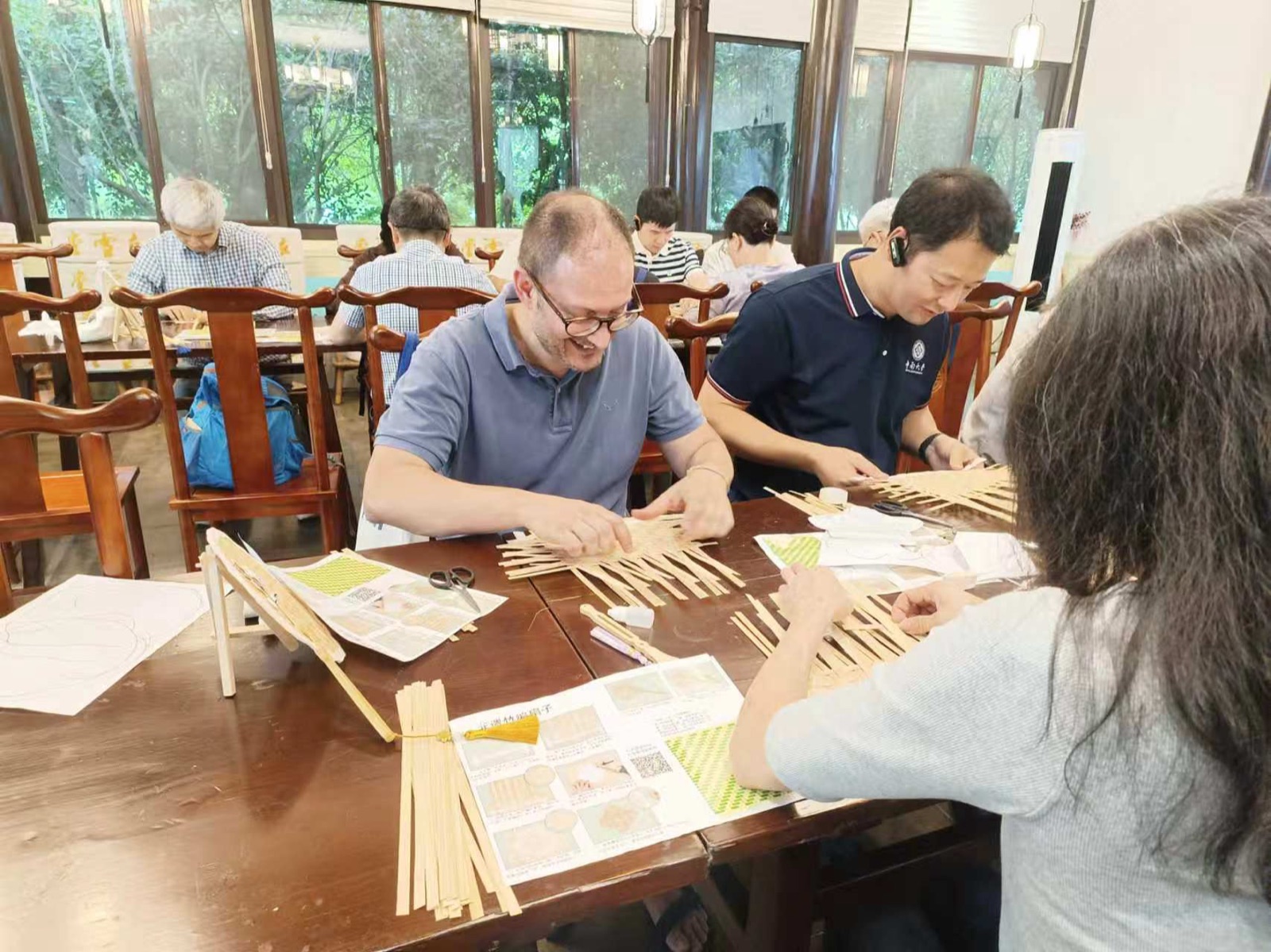
- Hands-on classes — pre-shaved strips let you weave a coaster, small tray, fan or basket; most sessions run one to two hours and you keep the piece.
Pair it with painting an oil-paper umbrella or learning paper-cutting, and plan the wider route with the East China heritage hub.
Frequently asked questions
What is Chinese bamboo weaving?
Bamboo weaving (竹编, zhúbiān) is a traditional Chinese craft in which split bamboo is shaved into thin, even strips and plaited into baskets, trays, fans, boxes and mats. It is strongest in the Jiangnan region of East China — Zhejiang, Anhui and the water towns — where it is protected as national intangible cultural heritage.
Where is the best place to try bamboo weaving?
The Jiangnan water towns and craft villages of Zhejiang and Anhui are the heartland, and workshops around Suzhou and Hangzhou make the easiest bases for visitors. Many run hands-on sessions where you can watch a master weaver and then plait your own small piece.
Can I weave my own bamboo piece in a workshop?
Yes. Beginner sessions hand you pre-shaved strips so you can focus on the weaving itself — usually a coaster, small tray, fan or simple basket. Most sessions run about one to two hours and you keep what you make, which makes it popular with families.
Is bamboo weaving hard for a beginner?
It is one of the more approachable Chinese crafts. The hardest part — splitting and shaving the bamboo into fine even strips — is usually done for you, so a beginner learns the over-under and hexagonal weaves and can finish a small piece in a single sitting.
How can I tell hand-woven bamboo from a machine-made copy?
Hand-woven bamboo has slightly irregular strips, tight corners worked by hand, and a rim that is bound and tucked rather than glued. The strips show the natural grain and small tonal shifts, while machine or plastic imitations are perfectly uniform and often feel too light.
Keep exploring
Jiangnan · Living Heritage
Weave your own bamboo piece
Add a bamboo-weaving workshop to a Suzhou–Hangzhou or water-town trip alongside canals, tea and old-town lanes.

PandaTouring Newsletter
Get Travel Tips in Your Inbox
Insider guides, hidden gems, and exclusive deals for your China adventure — delivered weekly.
No spam, ever. Unsubscribe anytime.