Quick answer
Dongba script (东巴文) is the pictographic writing of the Naxi people around Lijiang— each word drawn as a tiny picture, and the only such script still in living use. It is kept by Dongba priests, and its ancient manuscripts are on UNESCO's Memory of the World register. Watch it written below.
Dongba script at a glance
| Chinese name | 东巴文 (Dōngbā wén) |
|---|---|
| People | Naxi (纳西族) |
| Home | Lijiang (丽江) region, Yunnan |
| Type | Pictographic / ideographic script |
| Characters | Around 1,400 picture-words |
| Keepers | Dongba priests (东巴) |
| Companion script | Geba (哥巴文), a syllabary for sounds & names |
| UNESCO | Naxi Dongba manuscripts — Memory of the World (2003) |
Why it matters
Almost every early writing system that began as pictures — Egyptian hieroglyphs, oracle-bone Chinese — either died out or evolved into abstract letters. Dongba did neither. Naxi Dongba priestsstill read, write and teach the picture-words today, which is why scholars call it the world's last living pictographic script. The priests used it to record creation myths, funeral rites and astrology in hand-painted manuscripts; the Ancient Naxi Dongba Literature Manuscriptswere inscribed on UNESCO's Memory of the World Register in 2003.
How the picture-words work
Most Dongba characters are recognisable pictures that stand for a thing or an idea. But the script is also a memory aid: a single character can cue a whole line of a chant rather than spelling it out word for word. For sounds and names the Naxi use a companion syllabary, Geba (哥巴文). A few signs you can start to read:
| Sign | How it reads |
|---|---|
| Sun | A ringed disc — often with a central dot or short rays. |
| Moon | A crescent, sometimes paired with the sun for 'day and night'. |
| Mountain | A row of peaks — the land below Jade Dragon Snow Mountain. |
| Water | Wavy lines for rivers, lakes and rain. |
| Person | A small figure; posture and add-ons change the meaning. |
| Eye | An almond shape with a pupil — 'to see', 'to watch'. |
Watch a Dongba keeper at work
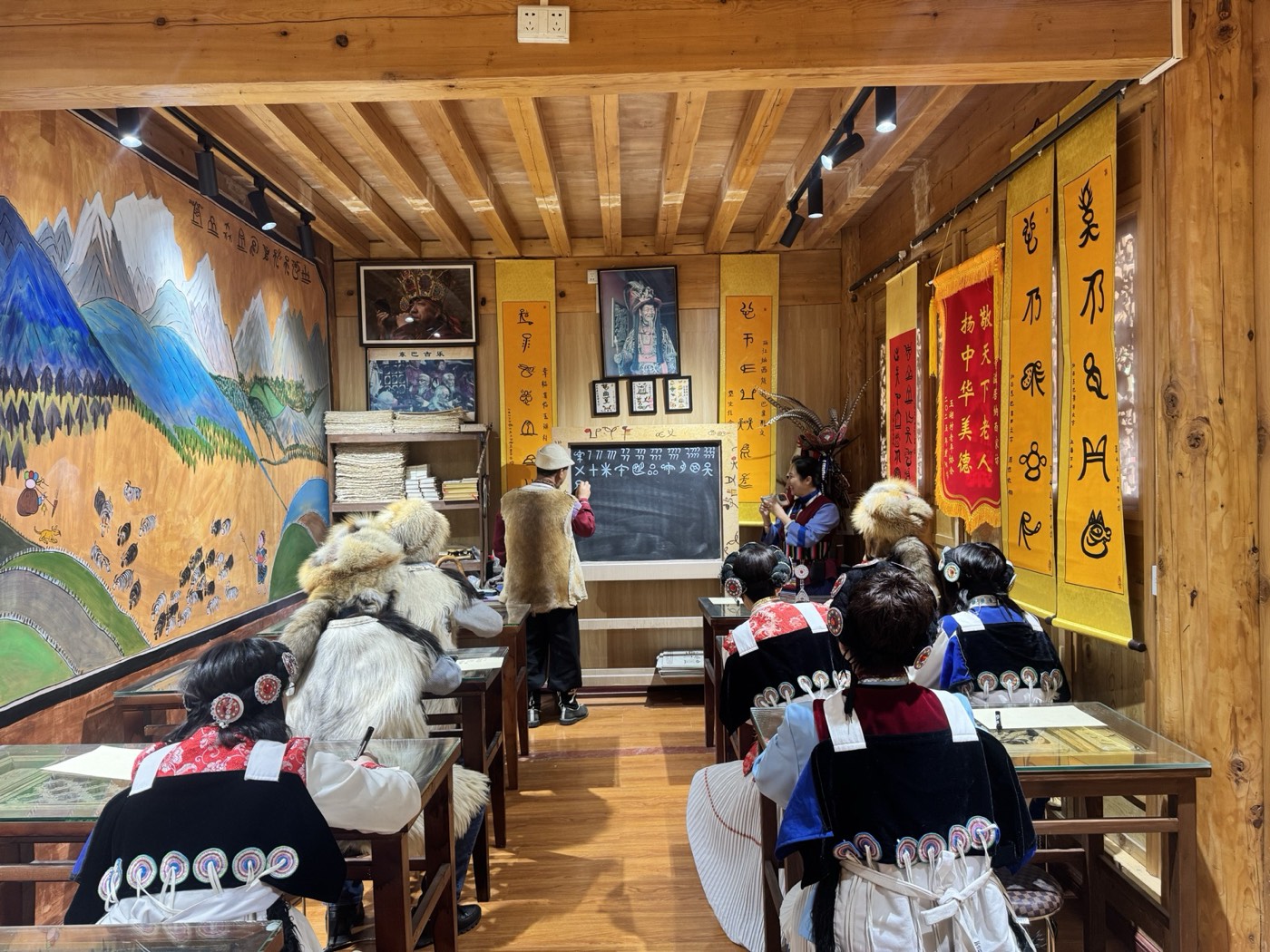
In a Lijiang culture house, a Dongba keeper in traditional dress writes the script beside the pictograph chart — the same characters visitors copy in the write-your-name workshops.
Where to see & try it in Lijiang
- Write-your-name workshops — a keeper writes your name in pictographs and helps you copy it onto handmade paper.
- Dongba Culture Museum — near Black Dragon Pool, for original manuscripts and ritual art.
- Baisha & Shuhe old towns — quieter neighbours of Lijiang with Dongba murals and studios.
It is the centrepiece of Naxi Dongba culture; pair it with Bai tie-dye down in Dali and plan the route with the Yunnan travel hub.
Frequently asked questions
What is Dongba script?
Dongba script (东巴文) is the pictographic writing of the Naxi people around Lijiang in Yunnan. Each word is drawn as a small picture, and the script is used by Dongba priests to record myths, rituals and astrology. It is widely described as the world's only pictographic script still in living use.
Why is Dongba called the 'last living pictographic script'?
Most of the world's early pictographic writing — such as Egyptian hieroglyphs — long ago died out or evolved into abstract letters. Dongba is still actively read, written and taught by Naxi Dongba keepers today, which is why it is called the last living pictographic script.
How does the writing work — is each picture a word?
Mostly yes: characters are pictures that stand for things and ideas. But a single Dongba character can also cue a whole line of a chant, working as a memory aid for the priest rather than a strict word-for-word text. A second script, Geba (哥巴文), is a syllabary used to spell out sounds and names.
Are the Dongba manuscripts protected?
Yes. The Ancient Naxi Dongba Literature Manuscripts were inscribed on UNESCO's Memory of the World Register in 2003. Tens of thousands of volumes survive in collections in Lijiang and around the world.
Can I learn to write my name in Dongba script?
Yes — it is one of the most popular hands-on experiences in Lijiang. At culture houses and workshops a Dongba keeper shows you the picture-characters and helps you write your name or a short phrase, usually on handmade paper you keep.
Keep exploring
Lijiang · Living Heritage
Write your name in pictographs
Add a Dongba script workshop to a Dali–Lijiang trip alongside old towns, snow mountains and tie-dye.

PandaTouring Newsletter
Get Travel Tips in Your Inbox
Insider guides, hidden gems, and exclusive deals for your China adventure — delivered weekly.
No spam, ever. Unsubscribe anytime.